Stargazing For Beginners
Introduction to stargazing with binoculars. An easy way to learn the stars, constellations, and basic astronomy.
Click Here!
Sunday, 27 November 2011
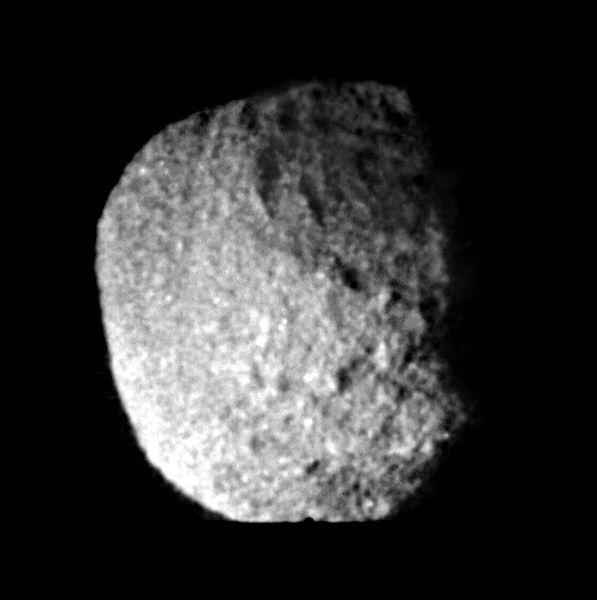
2nd Largest Moon of Neptune - Proteus (6th Moon outwards from Neptune)
Discovery
Proteus is the second largest Neptunian moon, and Neptune's largest inner satellite. Proteus is the 19th largest moon of the solar system.
Proteus was discovered from the images taken by Voyager 2 space probe two months before its Neptune flyby in August 1989. It received the temporary designation S/1989 N 1.
Naming
On 16 September 1991 S/1989 N 1 was named after Proteus, the shape-changing sea god of Greek mythology.
Stats
Diameter (mean): 420 km
Semi-major axis: 117,646 km
Orbital Period: 1.12 days
Orbit
Proteus orbits Neptune at the distance approximately equal to 4.75 equatorial radii of the planet. Its orbit has a small eccentricity and is inclined by about 0.5° to the planet's equator.
Proteus is the largest of the regular prograde satellites of Neptune. It rotates synchronously with the orbital motion, which means that one face always points to the planet.
Origin
Proteus, like the other inner satellites of Neptune, is unlikely to be an original body that formed with it, more probably having accreted from the wreak rubble that remained after Triton's capture.
Triton's orbit upon capture would have been highly eccentric, and would have caused chaotic perturbations in the orbits of the original inner Neptunian satellites, causing them to collide and reduce to a disc of rubble. Only after Triton's orbit became circularised did some of the rubble disc re-accrete into the present-day satellites.
Physical characteristics
Proteus, although about 420 km in diameter, is not spherical in shape. The shape of Proteus is close to a sphere with the radius of about 210 km, although deviations from the spherical shape are large—up to 20 km.
Scientists believe it is about as large as a body of its density can be without being pulled into a perfect spherical shape by its own gravity.
Proteus is slightly elongated in the direction of Neptune, although its overall the shape is closer to an irregular polyhedron than to a triaxial ellipsoid.
Saturday, 26 November 2011
2nd Largest Moon of Uranus - Oberon (18th Moon outwards from Uranus)
Oberon is the second largest of the Uranus moons and the tenth largest moon in the Solar System.
Discovery
Oberon was spotted by Sir William Herschel on January 11, 1787, six years after he had discovered the planet itself, on the same day he discovered Uranus's largest moon, Titania.
Naming
Oberon is named after the mythical king of the fairies who appears as a character in Shakespeare's A Midsummer Night's Dream.
Stats
Diameter: 1,522 km
Semi-major axis: 583,520 km
Orbital Period: 13.46 days
Orbit
Oberon orbits Uranus at a distance of about 583,520 km, being the farthest from the planet among its five major moons. Its orbital period is around 13.5 days, coincident with its rotational period. In other words, Oberon is a synchronous satellite, tidally locked, with one face always pointing toward the planet.
Oberon spends a significant part of its orbit outside the Uranian magnetosphere. As a result, its surface is directly struck by the solar wind.
Formation
Oberon probably formed from an accretion disk that surrounded the planet just after its formation.
The initial accretional heating together with continued decay of radioactive elements were probably strong enough to melt the ice if some antifreeze like ammonia (in the form of ammonia hydrate) or some salt was present.
Further melting may have led to the separation of ice from rocks and formation of a rocky core surrounded by an icy mantle. A layer of liquid water ('ocean') rich in dissolved ammonia may have formed at the core–mantle boundary.
The eutectic temperature of this mixture is 176 K. If the temperature dropped below this value the ocean would have frozen by now. Freezing of the water would have led to expansion of the interior, which may have also contributed to the formation of canyon-like graben. Still, present knowledge of the evolution of Oberon is very limited.
Exploration Status
So far the only close-up images of Oberon have been from the Voyager 2 probe, which photographed the moon during its flyby of Uranus in January 1986.
No other spacecraft has ever visited the Uranian system or Oberon, and no mission is planned in the foreseeable future.
Discovery
Oberon was spotted by Sir William Herschel on January 11, 1787, six years after he had discovered the planet itself, on the same day he discovered Uranus's largest moon, Titania.
Naming
Oberon is named after the mythical king of the fairies who appears as a character in Shakespeare's A Midsummer Night's Dream.
Stats
Diameter: 1,522 km
Semi-major axis: 583,520 km
Orbital Period: 13.46 days
Orbit
Oberon orbits Uranus at a distance of about 583,520 km, being the farthest from the planet among its five major moons. Its orbital period is around 13.5 days, coincident with its rotational period. In other words, Oberon is a synchronous satellite, tidally locked, with one face always pointing toward the planet.
Oberon spends a significant part of its orbit outside the Uranian magnetosphere. As a result, its surface is directly struck by the solar wind.
Formation
Oberon probably formed from an accretion disk that surrounded the planet just after its formation.
The initial accretional heating together with continued decay of radioactive elements were probably strong enough to melt the ice if some antifreeze like ammonia (in the form of ammonia hydrate) or some salt was present.
Further melting may have led to the separation of ice from rocks and formation of a rocky core surrounded by an icy mantle. A layer of liquid water ('ocean') rich in dissolved ammonia may have formed at the core–mantle boundary.
The eutectic temperature of this mixture is 176 K. If the temperature dropped below this value the ocean would have frozen by now. Freezing of the water would have led to expansion of the interior, which may have also contributed to the formation of canyon-like graben. Still, present knowledge of the evolution of Oberon is very limited.
Exploration Status
So far the only close-up images of Oberon have been from the Voyager 2 probe, which photographed the moon during its flyby of Uranus in January 1986.
No other spacecraft has ever visited the Uranian system or Oberon, and no mission is planned in the foreseeable future.
2nd Largest Moon of Saturn - Rhea (20th Moon outwards from Saturn)
Rhea is the second largest moon of Saturn and the nineth largest moon in the Solar System.
Discovery
It was discovered in 1672 by Giovanni Domenico Cassini. Cassini named the four moons he discovered (Tethys, Dione, Rhea and Iapetus) Sidera Lodoicea (the stars of Louis) to honor King Louis XIV.
Naming
Rhea is named after the Titan Rhea of Greek mythology.
Rhea was the Titaness daughter of Uranus, the sky, and Gaia, the earth, in Greek mythology. She was known as "the mother of gods". In earlier traditions, she was strongly associated with Gaia and Cybele, the Great Goddess, and was later seen by the classical Greeks as the mother of the Olympian gods and goddesses, though never dwelling permanently among them on Mount Olympus.
Stats
Diameter: 1,527 km
Semi-major axis: 527,108 km
Orbital Period: 4.52 days
Orbit
Rhea takes as long to rotate on its axis as it does to make one orbit of Saturn; and therefore always keeps the same hemisphere pointed to Saturn.
Possible ring system?
On March 6, 2008, NASA announced that Rhea may have a tenuous ring system. This would mark the first discovery of rings about a moon. The rings' existence was inferred by observed changes in the flow of electrons trapped by Saturn's magnetic field as Cassini passed by Rhea.
Dust and debris could extend out to Rhea's Hill sphere, but were thought to be denser nearer the moon, with three narrow rings of higher density. The case for a ring was strengthened by the subsequent finding of the presence of a set of small ultraviolet-bright spots distributed along Rhea's equator (interpreted as the impact points of deorbiting ring material).
However, when Cassini made targeted observations of the putative ring plane from several angles, no evidence of ring material was found, suggesting that another explanation for the earlier observations is needed.
Surface features
Rhea has a rather typical heavily cratered surface, with the exceptions of a few large fractures (wispy terrain) on the trailing hemisphere (the side facing away from the direction of motion along Rhea's orbit) and a very faint "line" of material at Rhea's equator that may have been deposited by material deorbiting from its rings.
Its surface can be divided into two geologically different areas based on crater density. The first area contains craters which are larger than 40 km in diameter. The second area, in parts of the polar and equatorial regions, has only craters under that size. This suggests that a major resurfacing event occurred some time during its formation.
Atmosphere
On November 27, 2010, NASA announced the discovery of a tenuous atmosphere—exosphere. It consists of oxygen and carbon dioxide in proportion of roughly 5 to 2.
The surface density of the exosphere is from 105 to 106 molecules in a cubic centimeter depending on local temperature. The main source of oxygen is radiolysis of water ice at the surface by ions supplied by the magnetosphere of Saturn. The source of the carbon dioxide is less clear, but it may be related to oxidation of the organics present in ice or to outgassing of the moon's interior.
Life?
Models suggest that Rhea could be capable of sustaining an internal liquid water ocean through heating by radioactive decay.
If there are thermal vents on the floor of this ocean as there are on Earth, it is remotely possible that similar organisms to those which live around the vents on Earth could also survive there.
Wednesday, 16 November 2011
2nd Largest Moon of Jupiter - Callisto (8th Moon outwards from Jupiter)
Callisto is the third-largest moon in the Solar System and the second largest in the Jovian system.
Discovery
Callisto's discovery is credited to Galileo Galilei, who was the first to observe it on January 7, 1610.
The satellite's name was soon suggested by astronomer Simon Marius. Callisto is named after one of Zeus's many lovers in Greek mythology. Callisto was a nymph (or, according to some sources, the daughter of Lycaon) who was associated with the goddess of the hunt, Artemis.
Together with Ganymede, Io and Europa, they are collectively known as Galilean satellites after the discover.
Stats
Diameter: 4,821 km
Semi-major axis: 1,882,709 km
Orbital Period: 16.69 days
Orbits
Callisto is the outermost of the four Galilean moons of Jupiter. It orbits at a distance of 1,882,709 km. This is significantly larger than the orbital radius —1,070,412 km— of the next-closest Galilean satellite, Ganymede. As a result of this relatively distant orbit, Callisto does not participate in the mean-motion resonance in which the three inner Galilean satellites are locked.
Callisto rotates synchronously with its orbital period, so the same hemisphere always faces (is tidally locked to) Jupiter. Callisto's surface is less affected by Jupiter's magnetosphere than the other inner satellites because it orbits farther away, and thus does not experience appreciable tidal heating.
Composition
Callisto is composed of approximately equal amounts of rock and ices. Compounds detected spectroscopically on the surface include water ice, carbon dioxide, silicates, and organic compounds. Investigation by the Galileo spacecraft revealed that Callisto may have a small silicate core and possibly a subsurface ocean of liquid water at depths greater than 100 km.
The surface of Callisto is heavily cratered and extremely old. It does not show any signatures of subsurface processes such as plate tectonics or volcanism, and is thought to have evolved predominantly under the influence of impacts.
Atmosphere
Callisto is surrounded by an extremely thin atmosphere composed of carbon dioxide and probably molecular oxygen, as well as by a rather intense ionosphere.
Life?
There is a distinct possibility that Callisto's saltwater ocean could harbour life. If there are thermal vents on the floor of this saltwater ocean as there are on Earth, it is remotely possible that similar organisms to those which live around the vents on Earth could also survive there.
Life has less chance at Callisto than at Europa and Ganymede, because Callisto orbits further away from Jupiter and lack the tidal heat energy.
Sunday, 13 November 2011
Quasi-satellite of Venus - Asteroid 2002 VE68
A quasi-satellite is an object in a 1:1 orbital resonance with its planet that stays close to the planet over many orbital periods.
A quasi-satellite's orbit around the Sun takes exactly the same time as the planet's, but has a different eccentricity (usually greater). When viewed from the perspective of the planet, the quasi-satellite will appear to travel in an oblong retrograde loop around the planet.
In contrast to true satellites, quasi-satellite orbits lie outside the planet's Hill sphere, and are unstable. Over time they tend to evolve to other types of resonant motion, where they no longer remain in the planet's neighbourhood, then possibly later move back to a quasi-satellite orbit, etc.
Asteroid 2002 VE68 is a quasi-satellite of Venus. It was discovered on November 11, 2002, by Lowell Observatory Near-Earth-Object Search (LONEOS).
Stats
Asteroid Family Group: Aten asteroid
Diameter: 210 - 470 m
Semi-major axis: 0.724 AU (same as Venus)
Rotation: 13.5 hours
The asteroid 2002 VE68 is currently a quasi-satellite of Venus, the first object of this dynamical class to be discovered, and is also the first known co-orbital companion to Venus.
This asteroid is also a Mercury grazer and an Earth crosser; it seems to have been co-orbital with Venus for only the last 7000 years, and is destined to be ejected from this orbital arrangement about 500 years from now. During this time, its distance to Venus has been and will remain larger than about 0.2 AU.
It has a high eccentricity (~ 0.4) and inclination (~ 9°). Consequently the maximum distance of the asteroid from the Sun is near that of the Earth and the minimum distance is smaller than the aphelion of Mercury.
From the evolution of the orbit of this object, it may have been a near-Earth asteroid, which, some 7000 yr ago, was injected into its present orbit by the action of the Earth.
A quasi-satellite's orbit around the Sun takes exactly the same time as the planet's, but has a different eccentricity (usually greater). When viewed from the perspective of the planet, the quasi-satellite will appear to travel in an oblong retrograde loop around the planet.
In contrast to true satellites, quasi-satellite orbits lie outside the planet's Hill sphere, and are unstable. Over time they tend to evolve to other types of resonant motion, where they no longer remain in the planet's neighbourhood, then possibly later move back to a quasi-satellite orbit, etc.
Asteroid 2002 VE68 is a quasi-satellite of Venus. It was discovered on November 11, 2002, by Lowell Observatory Near-Earth-Object Search (LONEOS).
Stats
Asteroid Family Group: Aten asteroid
Diameter: 210 - 470 m
Semi-major axis: 0.724 AU (same as Venus)
Rotation: 13.5 hours
The asteroid 2002 VE68 is currently a quasi-satellite of Venus, the first object of this dynamical class to be discovered, and is also the first known co-orbital companion to Venus.
This asteroid is also a Mercury grazer and an Earth crosser; it seems to have been co-orbital with Venus for only the last 7000 years, and is destined to be ejected from this orbital arrangement about 500 years from now. During this time, its distance to Venus has been and will remain larger than about 0.2 AU.
It has a high eccentricity (~ 0.4) and inclination (~ 9°). Consequently the maximum distance of the asteroid from the Sun is near that of the Earth and the minimum distance is smaller than the aphelion of Mercury.
From the evolution of the orbit of this object, it may have been a near-Earth asteroid, which, some 7000 yr ago, was injected into its present orbit by the action of the Earth.
Ceres - Largest asteroid, Smallest dwarf planet
Discovery
The idea that an undiscovered planet could exist between the orbits of Mars and Jupiter was first suggested by Johann Elert Bode in 1772.
His considerations were based on the Titius–Bode law, a now abandoned theory which had been first proposed by Johann Daniel Titius in 1766, observing that there was a regular pattern in the semi-major axes of the known planets marred only by the large gap between Mars and Jupiter. The pattern predicted that the missing planet ought to have a semi-major axis near 2.8 AU.
William Herschel's discovery of Uranus in 1781 near the predicted distance for the next body beyond Saturn increased faith in the law of Titius and Bode. In 1800, requests were sent to twenty-four experienced astronomers, asking that they combine their efforts and begin a methodical search for the expected planet.
One of the astronomers selected for the search was Giuseppe Piazzi at the Academy of Palermo, Sicily. Before receiving his invitation to join the group, Giuseppe Piazzi discovered Ceres on 1 January 1801. He was searching for "the 87th [star] of the Catalogue of the Zodiacal stars of Mr la Caille", but found that "it was preceded by another". Instead of a star, Piazzi had found a moving star-like object, which he first thought was a comet.
Naming
Piazzi originally suggested the name Cerere Ferdinandea for his discovery, after both the mythological figure Ceres (Roman goddess of agriculture) and King Ferdinand III of Sicily. "Ferdinandea" was not acceptable to other nations of the world and was thus dropped.
Stats
Diameter: 952 km
Semi-major axis: 2.766 AU
Orbital Period: 4.60 years
Rotation period: 9.07 hrs
Date discovered: 1801.1.1
Class: G
Type: Main-belt Asteroid
Status
The classification of Ceres has changed more than once. disagreement. Johann Elert Bode believed Ceres to be the "missing planet" he had proposed to exist between Mars and Jupiter, at a distance of 419 million km (2.8 AU) from the Sun. Ceres remained listed as a planet in astronomy books and tables (along with 2 Pallas, 3 Juno and 4 Vesta) for about half a century.
As other objects were discovered in the area it was realised that Ceres represented the first of a class of many similar bodies. In 1802 Sir William Herschel coined the term asteroid ("star-like") for such bodies, writing "they resemble small stars so much as hardly to be distinguished from them, even by very good telescopes". As the first such body to be discovered, it was given the designation "1 Ceres" under the modern system of asteroid numbering.
The 2006 debate surrounding Pluto and what constitutes a 'planet' led to Ceres being considered for reclassification as a planet. A proposal before the International Astronomical Union for the definition of a planet would have defined a planet as "a celestial body that:
(a) has sufficient mass for its self-gravity to overcome rigid-body forces so that it assumes a hydrostatic equilibrium (nearly round) shape, and
(b) is in orbit around a star, and is neither a star nor a satellite of a planet".
Had this resolution been adopted, it would have made Ceres the fifth planet in order from the Sun. It was not accepted, and in its place an alternate definition came into effect as of 24 August 2006, carrying the additional requirement that:
(c) a "planet" must have "cleared the neighborhood around its orbit".
By this definition, Ceres is not a planet because it does not dominate its orbit, sharing it as it does with the thousands of other asteroids in the asteroid belt and constituting only about a third of the total mass.
It is instead now classified as a dwarf planet.
Saturday, 12 November 2011
Titius–Bode law - How Ceres was found
The Titius–Bode law (sometimes termed just Bode's law) is a hypothesis that the bodies in some orbital systems, including the Sun's, orbit at semi-major axes in a function of planetary sequence. The hypothesis correctly predicted the orbits of Ceres and Uranus, but failed as a predictor of Neptune's orbit.
The formula
The best way to see the law is to write down the sequence 0, 3, 6, 12 and so on, where each number is obtained by doubling its predecessor. Next, add 4 to each number, and divide the result by 10.
For example, Venus = (3+4)/10 = 0.7
Now get out any astronomy textbook and look up the distances of the planets from the Sun in astronomical units, the Earth-Sun distance being defined as 1. The distances are virtually identical to the terms in the number sequence for all but the outermost planets.
It was regarded as interesting, but of no great importance until the discovery of Uranus in 1781 which happens to fit neatly into the series.
Based on this discovery, Bode urged a search for a planet between Mars and Jupiter. Ceres, the largest object in the asteroid belt, was found at Bode's predicted position in 1801.
Bode's law was then widely accepted until Neptune was discovered in 1846 and found not to satisfy Bode's law.
Theoretical explanations
There is no solid theoretical explanation of the Titius–Bode law, but if there is one it is possibly a combination of orbital resonance and shortage of degrees of freedom: any stable planetary system has a high probability of satisfying a Titius–Bode-type relationship. Because of this, it has been called a "rule" rather than a "law".
Orbital resonance from major orbiting bodies creates regions around the Sun that are free of long-term stable orbits. Results from simulations of planetary formation support the idea that a randomly chosen stable planetary system will likely satisfy a Titius–Bode law.
Still, Titius–Bode law may be just a coincidence. And we really do not have other planetary systems to test it.
The formula
The best way to see the law is to write down the sequence 0, 3, 6, 12 and so on, where each number is obtained by doubling its predecessor. Next, add 4 to each number, and divide the result by 10.
For example, Venus = (3+4)/10 = 0.7
Now get out any astronomy textbook and look up the distances of the planets from the Sun in astronomical units, the Earth-Sun distance being defined as 1. The distances are virtually identical to the terms in the number sequence for all but the outermost planets.
Planet Titius–Bode law distance Actual distance Mercury 0.4 0.39 Venus 0.7 0.72 Earth 1.0 1.0 Mars 1.6 1.52 Ceres 2.8 2.77 Jupiter 5.2 5.2 Saturn 10.0 9.74 Uranus 19.6 19.2 Neptune 38.8 30.06When originally published, the law was approximately satisfied by all the known planets — Mercury through Saturn — with a gap between the fourth and fifth planets.
It was regarded as interesting, but of no great importance until the discovery of Uranus in 1781 which happens to fit neatly into the series.
Based on this discovery, Bode urged a search for a planet between Mars and Jupiter. Ceres, the largest object in the asteroid belt, was found at Bode's predicted position in 1801.
Bode's law was then widely accepted until Neptune was discovered in 1846 and found not to satisfy Bode's law.
Theoretical explanations
There is no solid theoretical explanation of the Titius–Bode law, but if there is one it is possibly a combination of orbital resonance and shortage of degrees of freedom: any stable planetary system has a high probability of satisfying a Titius–Bode-type relationship. Because of this, it has been called a "rule" rather than a "law".
Orbital resonance from major orbiting bodies creates regions around the Sun that are free of long-term stable orbits. Results from simulations of planetary formation support the idea that a randomly chosen stable planetary system will likely satisfy a Titius–Bode law.
Still, Titius–Bode law may be just a coincidence. And we really do not have other planetary systems to test it.
Subscribe to:
Posts (Atom)


